Why the demo matters more under a £5 stake cap
Since April, the UKGC's £5 stake cap per spin — and £2.00 if you're under 25 — changed the economics of every slot session in the UK. You can't build a bankroll by ramping stakes mid-session, and you can't test a game's bonus frequency without burning through real money at the highest allowable bet.
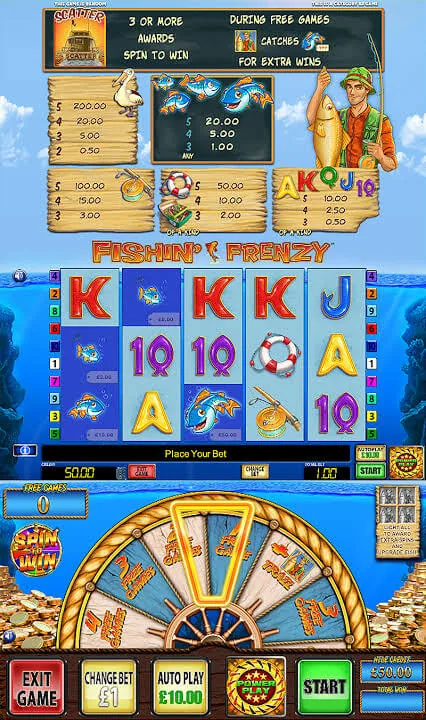
That makes the demo version of Fishin Frenzy more than a preview. It's the only way to clock the free spins trigger rate, measure how often the fisherman wild actually lands during the bonus, and decide whether 10p or £1.00 spins make sense for your budget — all before you hand over a debit card and sit through age verification.
What you're actually playing when you load the demo
The demo runs the same Blueprint Gaming engine as the real-money version: 5 reels, 3 rows, 10 fixed paylines, 96.12% RTP, medium volatility. The random number generator is identical, the paytable is identical, and the free spins mechanic — where the fisherman wild collects every fish value on screen — works exactly as it does when you've got £50.00 sitting in your casino balance.
You start with a virtual credit balance, usually 1,000 or 5,000 units depending on the site. No registration, no age check, no payment details. You can spin at any stake the demo allows — often from £0.10 to £100.00, though the real-money version will block you at £5.00 or £2.00 once you deposit — and reload the page to reset your balance if you drain it.
The demo hides three things: withdrawal times, KYC document requests, and bonus wagering requirements. You won't see a cashier, you won't see Faster Payments options, and you won't see the 35x or 40x playthrough that attaches to a welcome offer. But the game itself — the maths, the hit rate, the bonus trigger frequency — is the real thing.
Where the £5 stake cap changes your demo strategy
In the demo, you can spin at £10.00, £20.00, or £100.00 if you want to see what a big-win animation looks like. In real money, the UKGC caps you at £5.00 per spin if you're 25 or older, and £2.00 if you're between 18 and 24. That ceiling is enforced across every UKGC-licensed site — it's in the licence conditions, not the operator's choice.
So the demo becomes a testing ground for lower stakes. Spin at £0.10, £0.20, and £0.50 to see how long your bankroll lasts before the free spins trigger. Medium volatility means the bonus round should land roughly every 150–200 spins, but variance swings both ways, and you might wait 300 spins or hit it twice in 50.
- At £0.10 per spin, a £20.00 deposit covers 200 spins — enough to expect one or two bonus rounds, but not guaranteed.
- At £1.00 per spin, the same £20.00 gives you 20 spins, and you're relying on a quick trigger or a strong base-game run.
- At £5.00 per spin, you're through £20.00 in four spins, and a single bonus round needs to return 4x just to break even.
The demo lets you track those numbers without the affordability check that kicks in once your net deposits hit £150.00 a month. That check pulls data from credit reference agencies, and if your finances don't support the pattern, the operator can block deposits or close your account. You won't see that friction in demo mode.
The numbers that carry over and the ones that don't
RTP, volatility, and hit frequency: identical. The 96.12% return-to-player figure applies to both demo and real money, calculated over millions of spins. Medium volatility means mid-sized wins with moderate frequency, and the paytable — 500x for five fisherman wilds, down to 5x for three low symbols — stays the same.
Maximum win: the demo might show 5,000x or 50,000x depending on which variant you're playing, but real-money sessions on UKGC sites are often capped at £250,000 per game round regardless of the multiplier. If you're spinning at £5.00 and somehow hit 50,000x, you'll collect £250,000, not the full £250,000.
Bonus trigger rate: consistent in theory, chaotic in practice. The demo might give you three bonus rounds in 100 spins or none in 400. That's variance, and it follows you into real money. The difference is that in the demo, you reload the page and start again. In real money, you're into your debit card or PayPal balance, and the next deposit triggers another round of affordability checks.
What the demo hides: KYC, wagering, and withdrawal windows
The demo skips age verification. Real-money play on a UKGC site requires proof you're 18 or over before you can deposit — usually a driving licence, passport, or recent utility bill. That check happens within 24 hours of registration, and if you don't upload documents, your account is frozen.
Withdrawals take longer than the demo suggests. E-wallets like PayPal clear in a few hours to 24 hours, Faster Payments to your bank take the same day to two working days, and debit card withdrawals take one to three working days. The first withdrawal is always the slowest because the operator runs a secondary ID check and verifies the payment method is in your own name — credit cards have been banned for gambling since 2020.
Bonus wagering: if you take a welcome offer — 50 free spins, a deposit match, or a cashback deal — any winnings are locked behind a playthrough requirement, typically 35x to 40x. Win £20.00 from free spins with 35x wagering, and you need to cycle £700.00 through slots before you can withdraw. The demo never shows this, because there's no cashier and no bonus terms.
GAMSTOP: if you've self-excluded through the national scheme, every UKGC-licensed site is blocked for six months to five years depending on the term you chose. The demo might still load because it doesn't check the register, but the moment you try to register or log in, the block kicks in.
Demo play on a phone: no app, just the browser
Fishin Frenzy runs in mobile browsers — Safari on iOS, Chrome on Android — without an app install. Load the casino site or the demo page, tap the game tile, and it opens in HTML5. The reel grid scales to fit your screen, the paytable sits behind a menu icon, and the spin button moves to thumb reach at the bottom right.
Some UKGC operators do offer dedicated casino apps through the App Store and Google Play, but Fishin Frenzy itself doesn't have a standalone app. You're always playing the browser version, whether it's embedded in an operator's app or accessed directly through the site.
Demo play on mobile has one quirk: many UKGC sites gate the demo behind a logged-in, age-verified account. You'll see the game tile, tap 'Demo', and hit a login wall. That's a regulatory choice — the UKGC wants operators to confirm the player is over 18 before they see gambling content, even in free play. Not every site enforces this, but enough do that you should expect to register and verify your age before the demo loads.
Switching from demo to real money without torching your deposit
Once you've clocked 200 or 300 demo spins and you've got a feel for the bonus frequency, the lowest-risk path into real money is a small first deposit — £10.00 or £20.00 — and the lowest stake the game allows, usually £0.10 per spin.
Skip the welcome bonus if you're testing. Bonuses lock your deposit and winnings behind wagering requirements, and you can't withdraw until you've cleared the playthrough. A no-bonus deposit clears in hours once you request a withdrawal, and you keep full control of your balance.
- Register with a UKGC-licensed site — check the register at gamblingcommission.gov.uk and match the licence number in the footer.
- Upload ID during or immediately after registration to avoid delays later.
- Deposit £10.00 or £20.00 via debit card, PayPal, or Open Banking — all are instant, and you'll see the balance in seconds.
- Set a deposit limit during registration or in account settings — £50.00 a month, for example — so you can't chase losses.
- Spin at £0.10 or £0.20 until you've either hit a bonus round or spent the amount you're comfortable losing.
- Withdraw any remaining balance to test the cashier and see how long your first payout takes.
The first withdrawal triggers document verification if you didn't complete it at registration. The operator checks your ID, proof of address, and payment method ownership, and that process adds 24 to 48 hours to the payout window. Every withdrawal after that is faster — e-wallets in hours, bank transfers same day or next day.
When the demo stops being useful
The demo is a reliable model for the game's maths — RTP, volatility, bonus frequency — but it can't replicate the psychological weight of real money. A £5.00 spin in demo mode costs nothing; a £5.00 spin in real money is five pints, a meal, or an hour's wages, and that changes how you react to a dead spin or a weak bonus round.
It also hides the constraints that govern real play: the £5.00 and £2.00 stake caps, the affordability checks from £150.00 a month, the KYC document requests, the bonus wagering terms, and the withdrawal windows. You can spin 10,000 times in demo mode without seeing any of those, and then the first £20.00 deposit drops you into the full regulatory apparatus.
Use the demo to learn the game — where the bonus trigger sits, how the fisherman wild behaves, what the paytable looks like at different stakes. Then switch to real money at the lowest stake you're comfortable with, set a monthly deposit limit, and treat every session as a fixed-cost entertainment budget. The demo won't teach you bankroll discipline, and it won't show you how long £50.00 lasts at £1.00 a spin when variance runs cold. That only comes from real sessions with real money, and by then the learning curve is expensive.
FAQ
Can I play the Fishin Frenzy demo without registering on a UKGC site?
It depends on the operator. Some UKGC-licensed sites let you load the demo without an account, while others gate it behind a logged-in, age-verified session. The regulator encourages age checks even for free play, so expect to register and upload ID on roughly half the sites you try. Once you're verified, the demo is unlimited — no timer, no spin cap, no deposit required.
Does the demo version show the same RTP and volatility as real money?
Yes. The demo runs at 96.12% RTP and medium volatility, identical to the real-money version. The random number generator, paytable, and bonus mechanics are the same. The only differences are the stake caps — demo mode might let you spin at £100.00, while real money stops you at £5.00 or £2.00 depending on your age — and the absence of withdrawal windows, KYC checks, and bonus wagering terms.
If I hit a big win in demo mode, would the same win be possible in real money?
The multiplier is possible, but the payout might be capped. Fishin Frenzy can deliver wins up to 5,000x or 50,000x depending on the variant, but UKGC sites often cap winnings at £250,000 per game round. If you're spinning at £5.00 and hit 50,000x, you'll collect the cap, not the full £250,000. The demo doesn't show this ceiling because there's no real money at stake.
How do I switch from demo to real money without losing my deposit in the first session?
Start with a small deposit — £10.00 or £20.00 — and spin at the lowest stake, usually £0.10. Skip the welcome bonus so your balance isn't locked behind wagering requirements, and set a monthly deposit limit during registration to prevent chasing losses. Play until you've either hit a bonus round or spent the amount you budgeted, then withdraw any remaining balance to test the cashier. The first payout takes 24 to 48 hours because the operator verifies your documents, but every withdrawal after that clears faster.